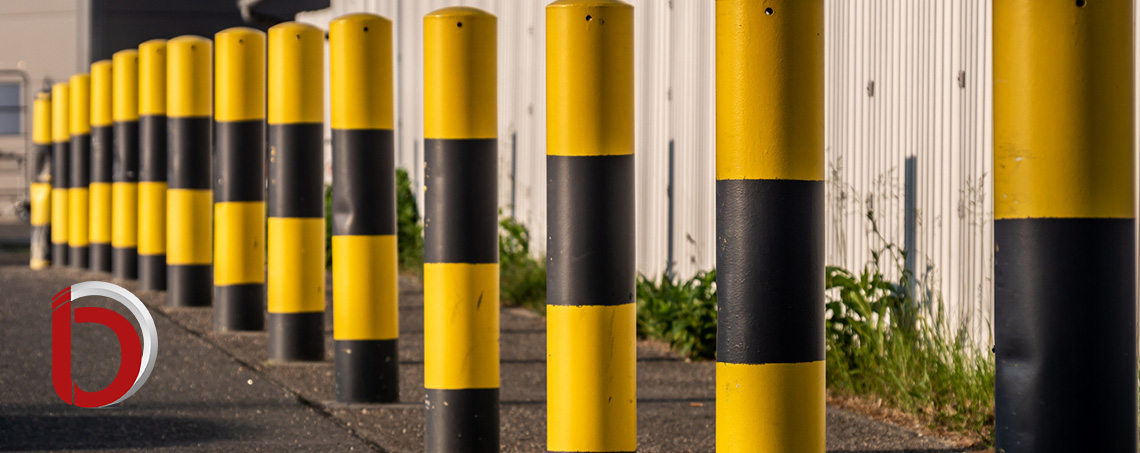
Crashes, age and exposure can weaken even the strongest bollards’ functionality and aesthetic appeal. Since they are important safety devices, designed to protect people, buildings and areas, it’s critical to know when to replace bollards vs. when repairs will suffice.
A leaning or wobbly bollard is a genuine safety concern. For fixed bollards, movement at the base, visible gaps or tilting can indicate foundation damage or loose anchors. Here, the concrete or foundation may need repair or full replacement.
For removable bollards, instability usually begins in the receiver sleeve, causing:
If the receiver loses structural integrity, the bollard cannot perform as intended and should be replaced.
High-impact rating bollards are built to withstand collisions, such as stopping a car, but the impact can compromise structural integrity. Dents, cracks or bending reduce the damaged bollard’s ability to function as originally intended.
For security-grade installations, any dents or damage could mean the bollard no longer meets crash performance standards, such as ASTM F2656-07 or ASTM F3016-14. In these situations, it’s safer and more cost-effective to replace it.
Steel is a heavy-duty material that offers excellent strength for bollards. Unfortunately, this metal relies on protective coatings, which can wear off, to prevent corrosion. Without an undamaged finish, moisture can gather and cause rust, weakening the bollard wall and base. When that rust and corrosion spread, the safest choice is to replace the bollards.
In areas where higher-impact rating bollards are needed, consider decorative bollard sleeves for preservation while maintaining safety. In areas where lower-impact bollards are sufficient, lighted bollards made from aluminum can offer greater longevity.
Depending on the missing part, a repair may be sufficient. If the decorative head falls off, the bollard can still function as intended. However, other components, like missing bolts, must be replaced immediately. Additionally, some bollards have features crucial for their intended usage, such as lift-assist systems, that you would need to replace otherwise.
Safety standards evolve, and older bollards may no longer meet current crash-rating requirements. Data from the Storefront Safety Council shows more than 100 vehicles collide into buildings daily in the U.S., highlighting the importance of updated bollards.
Standards like ASTM F3016-14 address low-speed impacts that are common in public and commercial environments. If your existing bollards were installed before these standards, it’s worth verifying compliance.
Blockaides can help you determine whether you should opt for bollard repair or replacement. If new bollards are the safest option, we can help you select the right bollards for your site, application and access needs. All Blockaides bollards are American-made, crash-rated to meet the latest safety standards and engineered to match your environment.
Contact Blockaides today to discuss your bollard replacement options.